Interest in mushroom grow bags in Italy has expanded alongside a broader shift toward more controlled, repeatable approaches to mycology. Instead of relying only on open containers and multiple manually managed components, researchers and hobbyists can now choose systems that integrate the growing medium, enclosure and passive gas exchange into a single format.
But not every mushroom grow bag works in the same way.
Some are simply empty polypropylene bags. Others contain sterilized substrate but still require several additional preparation stages. More integrated formats are supplied as closed biological systems designed to reduce the amount of handling required from the user.
For anyone comparing mycology supplies in Italy, the useful question is therefore not simply “Which bag is best?” It is which variables the system controls, which ones remain in the hands of the researcher, and which technical claims can actually be verified.
Why mushroom grow bags are becoming relevant in Italy
Italy already has an established commercial and scientific relationship with mushroom cultivation. The market includes specialist suppliers of substrates, spawn, laboratory equipment and autoclavable filter bags, alongside a long-standing professional cultivated-mushroom sector.
Italian suppliers increasingly offer polypropylene mushroom bags equipped with microporous filter patches, reflecting a broader cultivation technology used internationally for fungal research and commercial mushroom production.
Italian regulation also recognises the importance of identifiable, controlled propagation material within the professional cultivated-mushroom sector. A national decree published in the Gazzetta Ufficiale della Repubblica Italiana established rules concerning the production and commercialisation of propagation material for specified cultivated fungal species.
That legislation should not be interpreted as a certification of MycoBag or as a universal rule applying to every fungal species. It does, however, illustrate a wider professional principle: provenance, material quality and process control matter in serious mushroom production.
What is a mushroom grow bag?
A mushroom grow bag is a flexible enclosure designed to hold fungal growing media or other mycological material while allowing a degree of controlled interaction with the surrounding atmosphere.
Professional bags are commonly manufactured from heat-resistant polypropylene and may incorporate a microporous filter patch.
The filter is important because fungi are aerobic organisms. Their metabolism requires gas exchange, so simply sealing biological material inside an impermeable plastic bag would not create a useful controlled environment.
Research on commercial shiitake production has documented the use of polypropylene bags with microporous filter patches that both permit gas exchange and act as a microbial barrier. The study also found that filter porosity influenced biological performance, demonstrating that filtration is not merely a packaging feature but part of the cultivation environment.
You can review that research in Bioresource Technology.
Empty grow bag, substrate bag or integrated system?
The term “mushroom grow bag” covers several very different products.
| System |
What it normally contains |
User involvement |
| Empty filter bag |
Polypropylene enclosure and filter patch |
High |
| Prepared substrate bag |
Processed growing medium inside a filter bag |
Moderate |
| All-in-one grow bag |
Several biological components combined in one enclosure |
Varies by product |
| Closed Plug & Play system |
Prepared biological material, growing medium and filtered enclosure |
Lower |
This distinction matters when comparing products in Italy because two bags that look almost identical from the outside can require very different workflows.
A low-cost empty filter bag gives an experienced researcher maximum control over the materials placed inside it. A more integrated system trades some of that experimental flexibility for convenience and standardisation.
For a more detailed explanation of these product categories, see our comparison of all-in-one mushroom grow bags and traditional kits.
Why closed systems matter in mycological research
A controlled system is useful because fungal development is influenced by multiple interacting variables.
Substrate characteristics, biological material, moisture, atmospheric exchange and microbial competition can all affect what the researcher eventually observes.
The more variables that change simultaneously, the harder it becomes to interpret differences between biological samples.
A closed grow-bag format can therefore serve two different audiences.
For beginners, the advantage is reduced complexity. Fewer independent preparation stages have to be managed before observations can begin.
For experienced researchers, the advantage can be greater standardisation of the starting environment. Removing unnecessary handling variables makes comparisons between samples easier to interpret.
This does not mean a closed system makes every biological result identical. Fungi remain living organisms, and biological variability cannot be engineered away completely.
The science behind microporous filter patches
The filter patch is one of the most important components of a professional mushroom grow bag.
Its purpose is to reconcile two competing requirements:
- the fungal culture needs atmospheric exchange;
- the internal environment benefits from reduced exposure to external particles and microorganisms.
Scientific studies using filter bags for mushroom production have shown that the characteristics of the filter influence oxygen and carbon dioxide conditions inside the bag. Earlier research on shiitake also found that ventilation levels could affect mushroom development and contamination.
This means statements such as “more airflow is always better” or “the smallest possible filter is always superior” are overly simplistic.
Gas exchange is a biological variable, not simply a marketing specification.
Does a filter make a mushroom bag contamination-proof?
No.
A microporous filter can help reduce exposure to airborne contaminants while permitting gas exchange, but no grow bag should be described as biologically incapable of contamination.
Contamination can originate at several points within mushroom-production systems.
Research published in Food Science & Nutrition, for example, documented the possibility of cross-contamination even after earlier substrate-management processes had reduced or eliminated detectable microorganisms. The study illustrates why contamination control needs to be understood as a system rather than a single sterilization event.
The research is available through PubMed.
The more defensible advantage of a closed filter-bag system is therefore that it can reduce repeated environmental exposure and unnecessary manual handling.
For more background, see our guide to common mushroom growing problems and contamination.
Why reduced handling matters
Every interaction with a biological system introduces another variable.
This does not mean that opening a container automatically causes contamination, nor that open systems cannot be used successfully. Professional mushroom production employs many different enclosure designs and hygiene strategies.
What reduced handling changes is the number of opportunities for external variables to enter the process.
This distinction is important.
A scientifically credible closed-system claim is:
“Designed to reduce environmental exposure by reducing the need for manual intervention.”
A much less defensible claim would be:
“Completely eliminates contamination.”
MycoBag should compete on the first proposition, not the second.
Substrate still matters inside a grow bag
A high-quality enclosure cannot compensate for an unsuitable growing medium.
The substrate forms part of both the nutritional and physical environment of fungal development. Its structure influences properties such as water retention, porosity and the distribution of available resources.
The correct substrate also depends on the biological material being studied. There is no single universal mixture that can objectively be described as the best substrate for every mushroom species.
For a deeper explanation, read our guide to mushroom substrate and how to evaluate a growing medium.
In an integrated grow-bag system, the important advantage is not simply that substrate is present. It is that substrate preparation becomes part of a more defined production process instead of another variable that the end user must independently reproduce.
What makes MycoBag different from a conventional grow bag?
MycoBag is not positioned as an empty filter bag.
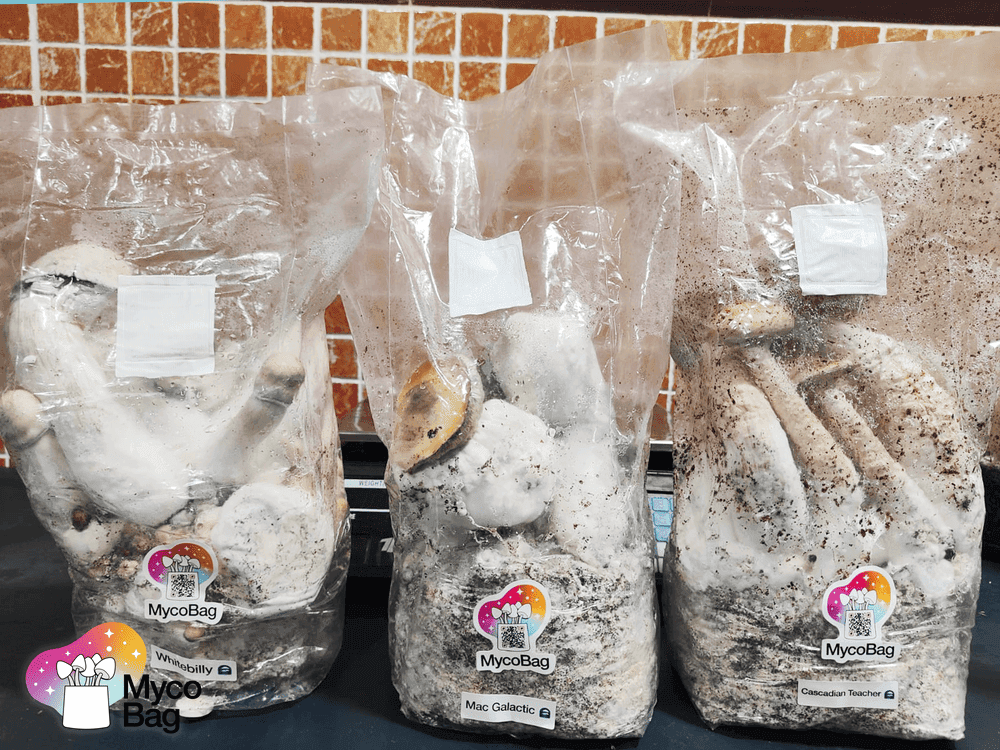
It is a closed Plug & Play system in which the growing medium and biological material are prepared before reaching the user.
The current MycoBag system combines several elements:
- a prepared substrate environment;
- selected fungal genetics;
- a sealed bag format;
- a microporous filter for passive gas exchange;
- and reduced need for user manipulation.
MycoBag currently states that commercial steam-autoclave processing forms part of its substrate preparation process. The relevant benefit of this preparation is not a guarantee that contamination can never occur, but that microbiological control takes place before the system reaches the end user.
Combined with the closed enclosure, this changes where responsibility for certain preparation variables sits: more of them are controlled during production and fewer are left for the customer to reproduce manually.
MycoBag vs traditional containers
Traditional rigid containers and filtered grow bags solve the same fundamental biological challenge in different ways.
| Factor |
Traditional container |
Closed MycoBag system |
| Enclosure |
Rigid |
Flexible sealed bag |
| Gas exchange |
Depends on system design |
Passive through an integrated filter |
| Manual interaction |
Can be higher |
Designed to be lower |
| Substrate preparation |
Often controlled by the user |
Prepared before delivery |
| Experimental flexibility |
Potentially high |
More standardised |
| Beginner complexity |
Depends strongly on configuration |
Designed to reduce preparation steps |
Neither architecture makes microbiological risk disappear. The main difference lies in how many environmental and preparation variables the user is expected to manage.
See our full MycoBag vs Tupper comparison for a closer look at these two approaches.
Why genetic provenance matters in a controlled system
Standardising the enclosure while ignoring the genetics would solve only part of the reproducibility problem.
A cultivar name can describe a selected line, but it should not automatically be interpreted as proof of fixed performance, potency or yield.
For research-focused users, the more meaningful questions are:
- Where did the biological material originate?
- Who selected or stabilised the line?
- Which characteristics are documented?
- Which observations come from the supplier?
- Which claims have been measured analytically?
MycoBag currently works with selected cultivars associated with Full Canopy Genetics.
The current catalogue includes Cascadian Teacher, Albino Jedi Mind Fuck, Whitebilly and Tidal Wave Ape, alongside other active MycoBag genetics.
Individual performance data should still be attributed to the source that generated it rather than converted into universal guarantees for the MycoBag format.
From visual observations to analytical data
Professional mycology depends on distinguishing observation from measurement.
Colour, morphology, density and other visible characteristics can all provide useful phenotypic information. But visual appearance alone cannot establish a precise biochemical profile.
This is especially relevant when studying cultivars associated with compounds such as psilocybin and psilocin. Potency cannot be reliably inferred from the cultivar name, fruiting-body dimensions or the intensity of blue bruising.
Where appropriate and legally permitted, laboratory analysis provides a more objective basis for comparing samples.
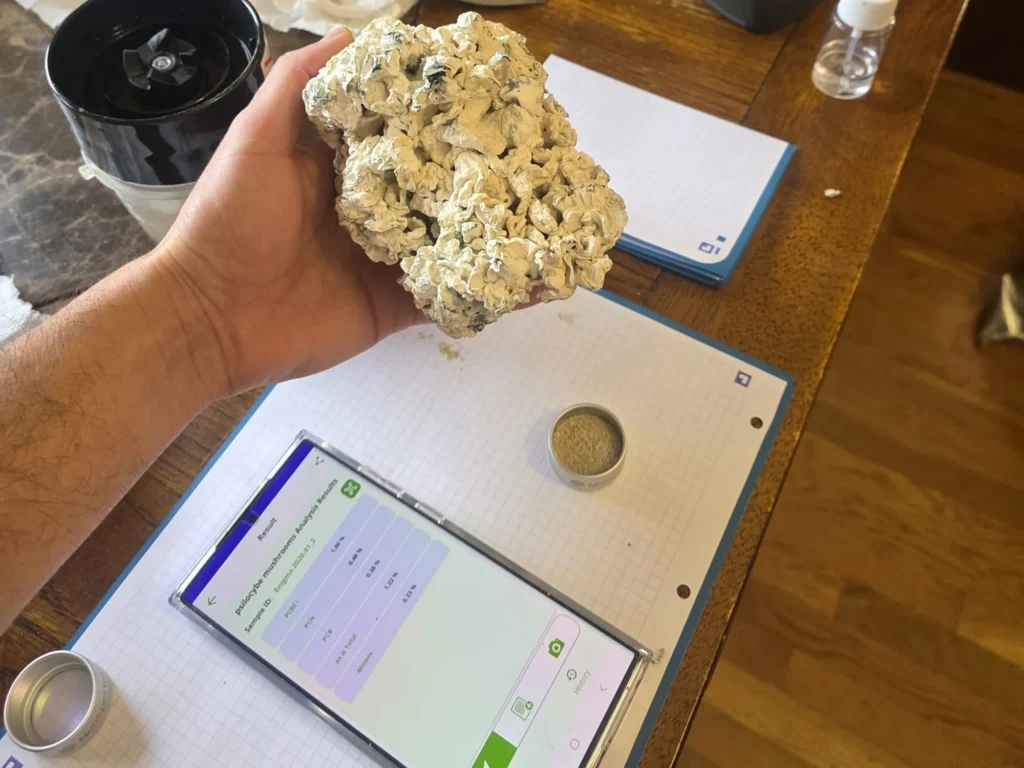
MycoBag’s MycoTest service is designed around sample analysis and currently reports metrics including psilocybin, combined psilocybin/psilocin values and total alkaloids.
The important methodological distinction remains the same: analytical results describe the sample tested, not every future specimen carrying the same cultivar name.
What should you compare when buying mushroom grow bags in Italy?
If you are evaluating mushroom grow bags or prepared mycology systems in Italy, technical specifications are more useful than dramatic marketing language.
Look at questions such as:
- Is the bag an empty enclosure or an integrated biological system?
- Does it include a microporous filter?
- Is the substrate already prepared?
- How much manual handling does the format require?
- Is the biological material clearly identified?
- Is genetic provenance documented?
- Are laboratory results attributed to the samples actually tested?
- Does the seller distinguish risk reduction from absolute guarantees?
These criteria make it much easier to compare an inexpensive empty bag with a complete prepared system without pretending they are equivalent products.
Is MycoBag suitable for beginners or experienced researchers?
The same closed-system architecture can serve different purposes depending on the user.
For a beginner, the principal advantage is simplicity. A prepared system reduces the number of independent components and processes that must be understood simultaneously.
For an experienced user, the attraction is different. A more standardised starting environment can help reduce variation introduced through repeated manual preparation.
This reflects the core MycoBag positioning:
simplicity and reduced handling for beginners; defined genetics, technical design and consistency for more experienced users.
Frequently asked questions about mushroom grow bags in Italy
Can you buy mushroom grow bags in Italy?
Yes. The Italian market includes specialist mycology suppliers offering empty filter bags, sterilized substrates, growing blocks and integrated grow-bag systems. The products differ substantially in what is included and how much preparation is required.
What is the difference between a filter bag and an all-in-one grow bag?
A filter bag may simply be an empty polypropylene enclosure with a microporous membrane. An all-in-one or prepared system can integrate substrate and other biological components inside the same enclosure.
What does a microporous filter do?
A microporous filter provides a pathway for passive gas exchange while helping reduce direct entry of environmental particles. Research on commercial mushroom bags has shown that filter characteristics can influence the internal gas environment and biological performance.
Are mushroom grow bags completely sterile?
Sterilization describes a microbiological treatment or condition at a particular stage of preparation. It should not be interpreted as a permanent guarantee that contamination can never occur after processing, transport or handling.
Do closed mushroom grow bags eliminate contamination?
No. Their main technical advantage is reducing unnecessary environmental exposure and manual interaction. They should be described as a risk-reduction strategy rather than a guarantee of zero contamination.
Are professional mushroom grow bags better than plastic containers?
Not universally. Traditional containers provide greater flexibility in some experimental contexts. Integrated grow bags are particularly useful when reducing handling and standardising the starting environment are higher priorities.
What is different about MycoBag?
MycoBag combines prepared biological material, a defined growing medium, selected genetics, a closed enclosure and passive gas exchange within a Plug & Play format. It is therefore more integrated than an empty mushroom cultivation bag.
Does Italy have a single official standard for mushroom grow bags?
There is no basis for describing one commercial bag design as “the Italian standard”. Italy has regulations relevant to areas of professional cultivated-mushroom production and propagation material, but product specifications and applicable rules depend on the material, species and intended use.
Final thoughts
The growing Italian mycology market makes mushroom grow bags in Italy increasingly easy to find. What matters is understanding what you are actually comparing.
An empty autoclavable bag, a sterilized substrate bag and an integrated closed system may share the same basic shape, but they transfer very different levels of preparation and process control to the user.
For MycoBag, the strongest proposition is not that closed bags represent an official Italian cultivation standard, nor that they make contamination impossible.
The more credible advantage is architectural: MycoBag combines prepared biological material, selected genetics, a closed Plug & Play enclosure and passive gas exchange in a system designed to reduce unnecessary handling.
For beginners, that means fewer variables to manage. For experienced users, it offers a more defined starting environment and clearer genetic provenance.
Explore the current MycoBag range

 Sale!
Sale! Sale!
Sale!