Elite mushroom genetics can influence morphology, development, consistency and yield potential. But genetics alone do not guarantee maximum yields.
This distinction matters. A well-selected and documented fungal lineage can reduce an important source of biological variability, but the final phenotype still results from an interaction between genetics, environment and natural biological variation.
So what makes a mushroom genetic line genuinely valuable, and how much can genetics really tell us about yield?
What does “elite mushroom genetics” actually mean?
“Elite genetics” is not a formal taxonomic or scientific classification. At MycoBag, we use the term as commercial shorthand for selected and documented cultivars: genetic lines whose provenance, phenotype or selection history can be described with more precision than a generic strain name.
The distinction is important because a name alone tells us relatively little. The useful questions are where a lineage came from, which characteristics were selected, who documented them and whether those traits have been observed consistently.
If you want a deeper explanation of terms such as cultivar, isolation, albino, leucistic and phenotype, see our guide to mushroom genetics.
How much can genetics influence mushroom yield?
Genetics contributes to the biological potential of a fungal culture. Different genetic backgrounds can express differences in morphology, development and other measurable characteristics.
That makes genetic selection relevant when studying yield potential. It does not, however, make yield a fixed genetic number.
A more accurate model is:
genetic potential + environment + biological variation = observed performance.
This is why two observations involving the same named cultivar do not necessarily produce identical outcomes. A selected lineage may provide a more consistent biological starting point, but phenotype and productivity remain influenced by the environment in which that potential is expressed.
Maximum yield potential is not the same as guaranteed yield
The phrase maximum yields is often used as if a genetic line contained a predetermined production figure. Biologically, that is too simplistic.
What selection can do is identify and preserve genetic material associated with characteristics considered desirable. These may include morphology, structural density, developmental behaviour or other observable traits.
What it cannot do is guarantee that every expression of that lineage will reproduce the same result.
For this reason, claims such as “highest yielding genetics” or “guaranteed maximum yield” require comparative evidence. Without that evidence, it is more accurate to talk about yield potential, selected traits and documented performance.
Why genetic stability matters
A useful genetic line is not only interesting because of the traits originally selected. Researchers also need to know whether relevant characteristics remain sufficiently consistent over time.
This is where strain stability becomes important.
Scientific literature on fungi describes strain degeneration as a possible loss or alteration of relevant characteristics during prolonged propagation. Genetic, epigenetic, environmental and ageing-related mechanisms can all contribute, although the processes vary between fungal species.
This means that “isolated” and “stable” should not automatically be treated as synonyms. Stability is something that needs to be observed and documented.
Does rhizomorphic mycelium mean better genetics?
Not necessarily.
Rhizomorphic mycelium describes a visible growth morphology characterised by more defined, strand-like structures. It can be useful as an observational characteristic, but appearance alone does not demonstrate superior genetics or higher yield.
Mycelial morphology is itself a phenotype and can be influenced by both genetic background and environmental conditions.
A visually vigorous culture may therefore be interesting to document, but rhizomorphic growth should not be presented as proof of maximum biological performance.
Albino Jedi Mind Fuck: genetics with documented provenance
Albino Jedi Mind Fuck provides a useful example of why provenance matters.
According to documentation supplied by Full Canopy Genetics, Albino Jedi Mind Fuck is an albino isolation related to the original Jedi Mind Fuck lineage. Full Canopy reports that its genetic material was acquired from Denver Mycology, later crossed with material received from Edward Grand and subsequently worked and stabilised.
The supplier also reports multiple rounds of laboratory testing between May 2023 and November 2025.
This gives us useful information about the lineage and its supplier-reported development history. It does not mean that individual laboratory results obtained by Full Canopy automatically become guaranteed results for every Albino Jedi Mind Fuck MycoBag.
Where MycoBag fits into the equation
Genetic potential becomes easier to interpret when unnecessary external variables are reduced.
MycoBag uses a closed Plug & Play system designed to minimise manual handling. Its microporous filter supports passive gas exchange while allowing the system to remain closed during its intended use.
The important point is not that the bag guarantees maximum yield. It is that a more contained system can reduce some environmental variability around the biological material.
For beginners, that means less unnecessary manipulation. For more experienced users, it provides a more controlled framework in which differences between documented genetic lines can be evaluated.
What should you look for in elite mushroom genetics?
Strong genetic documentation should answer a few basic questions: Is the lineage identifiable? Is its provenance documented? Which characteristics have actually been observed? Who produced the data? And are supplier results being clearly separated from product-specific results?
Those questions are more meaningful than labels such as “strongest”, “best” or “highest yielding”.
For MycoBag, the goal is therefore simple: selected genetics supported by traceable information rather than absolute performance promises.
Frequently asked questions
Do elite mushroom genetics guarantee maximum yields?
No. Genetics can influence biological potential, but final performance also depends on environmental conditions and natural biological variability.
Can two examples of the same cultivar perform differently?
Yes. Sharing a genetic background does not mean every observed phenotype or performance characteristic will be identical.
Does an isolated culture automatically mean stable genetics?
No. Isolation and long-term stability are different concepts. Stability needs to be evaluated and documented over time.
Does rhizomorphic mycelium prove high-yield genetics?
No. Rhizomorphic growth describes mycelial morphology. It can be an interesting characteristic, but it does not independently prove superior yield or overall genetic quality.
Explore the current MycoBag genetics catalogue and discover the documented characteristics behind each cultivar.


 Sale!
Sale! Sale!
Sale!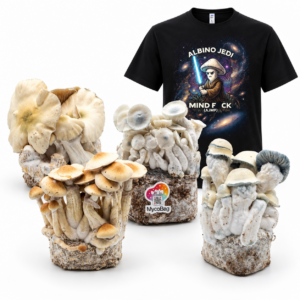 Sale!
Sale!