FREE SHIPPING ON ORDERS OVER 50€*
How are magic mushrooms cultivated? Scientifically, the process is better understood as controlled fungal propagation rather than simply “planting mushrooms”. Fungi do not grow from seeds and do not obtain energy through photosynthesis. Instead, a network of microscopic filaments known as mycelium develops through an organic growing medium before, under suitable biological conditions, forming fruiting bodies.
The exact cultivation system depends on the fungal species, genetic material, substrate and research objective. Laboratory cultivation can involve culture media, prepared substrates, controlled enclosures and carefully managed environmental variables, while modern integrated systems combine several of those elements into a single filtered format.
This guide explains the science behind magic mushroom cultivation, the major stages researchers study, how substrate and contamination affect the system, and how closed grow bags differ from traditional multi-stage methods.
| Stage | What happens biologically | Research focus |
|---|---|---|
| Genetic material | Fungal material provides the starting biological population | Identity, provenance and genetic variability |
| Mycelial development | Hyphae form an expanding mycelial network | Growth characteristics and culture health |
| Substrate colonisation | Mycelium develops through an organic growing medium | Nutrition, moisture, structure and gas exchange |
| Fruiting development | The fungus may form reproductive structures under suitable conditions | Phenotype and developmental biology |
| Analysis | Researchers examine morphology, genetics or chemistry | Identification, variability and reproducibility |
“Magic mushrooms” is an informal term rather than a scientific taxonomic category. It is commonly used for fungal species that naturally produce compounds such as psilocybin and psilocin.
The genus Psilocybe contains many of the best-known examples.
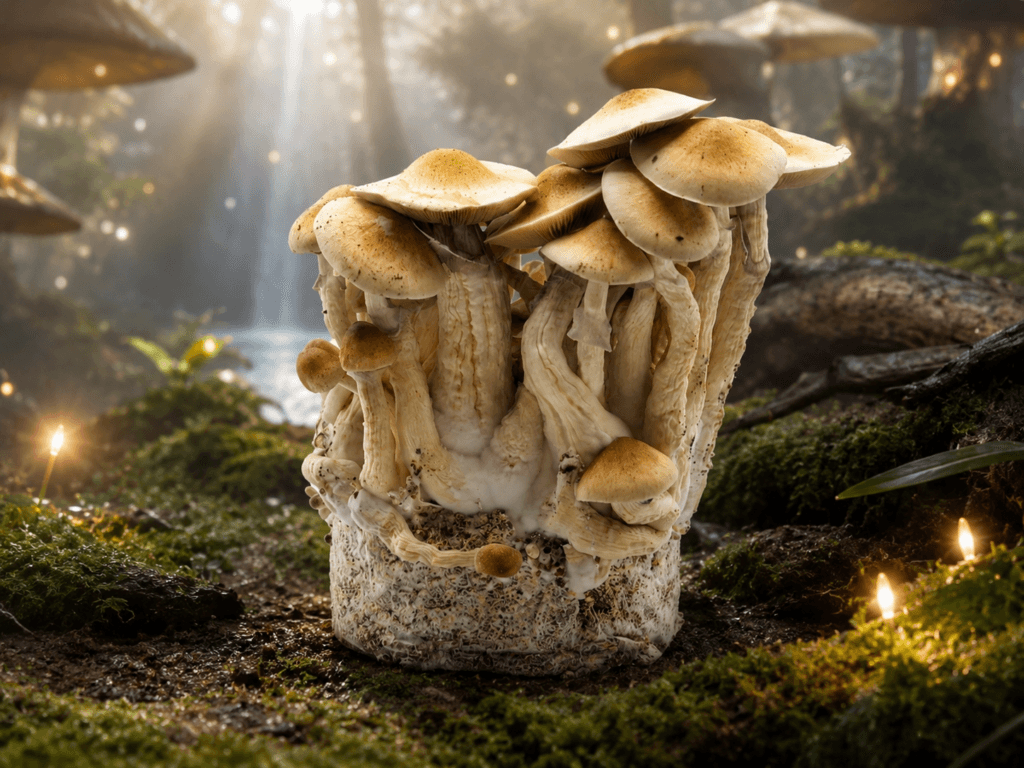
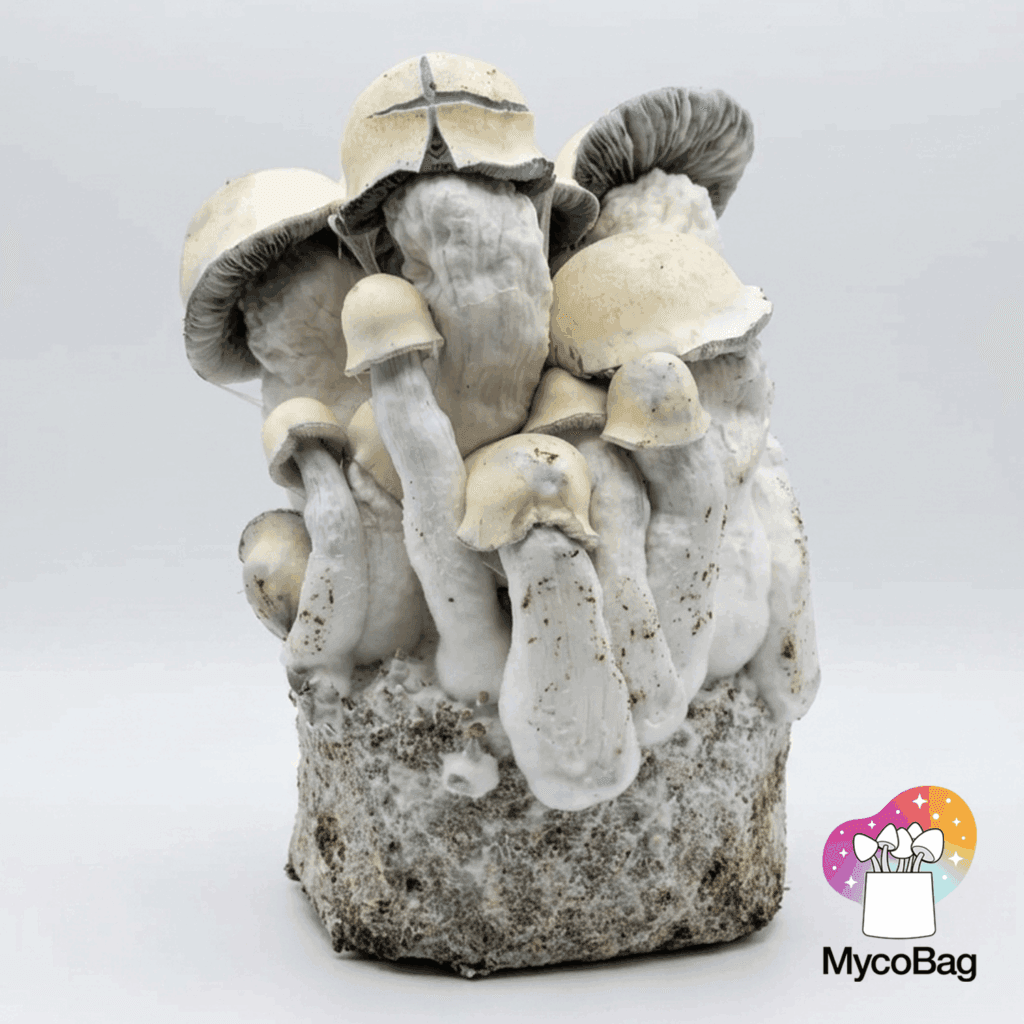
One of the most frequently studied cultivated species is Psilocybe cubensis. Within that species, names such as Golden Teacher, Tidal Wave, Albino Jedi Mind Fuck and Whitebilly refer to cultivated lines or commercial cultivar names rather than separate species.
You can verify the taxonomic classification of
Psilocybe cubensis through the
NCBI Taxonomy database
.
For a broader explanation of species, cultivars and genetic lines, read our
guide to magic mushroom varieties and genetics
.
In scientific settings, Psilocybe cultivation is generally approached as a sequence of biological stages rather than one single technique.
Researchers may begin with documented fungal material, establish a mycelial culture, introduce that material to an appropriate growing medium, allow the mycelium to develop through the substrate and then study later developmental stages under controlled conditions.
Peer-reviewed research on Psilocybe cultivation describes both conventional multi-stage methods and more streamlined experimental systems. The precise protocol varies with the species and scientific objective.
A recent study on Psilocybe cultivation and chemical reference materials demonstrates how researchers use defined cultures, substrates and controlled environments to produce material suitable for scientific analysis.
Every cultivation system begins with biological material.
Fungi reproduce through spores, but spores are not equivalent to plant seeds in a genetic sense. Material originating from multiple spores can produce considerable genetic variation.
Researchers may therefore distinguish between:
This matters because the genetic starting point can influence morphology, growth behaviour and other observable characteristics.
A peer-reviewed review of Psilocybe cubensis emphasises that genetic diversity and cultivar variability remain important areas of current research.
Read the scientific review of Psilocybe cubensis genetics and cultivation research.
For a deeper explanation of cultivar terminology, see our mushroom genetics guide.
The visible mushroom is only one stage in the fungal life cycle.
The organism develops primarily as mycelium: a network formed by microscopic filaments known as hyphae.
As the fungus develops through suitable organic material, that network expands and interacts with its environment by releasing enzymes and absorbing available nutrients.
This is fundamentally different from plant growth.
Plants use photosynthesis to capture energy from light. Fungi obtain resources by chemically breaking down compounds in the material around them.
That is why the growing medium plays such an important role in mushroom cultivation.
A mushroom substrate is the organic growing medium through which the mycelium develops.
There is no universal substrate appropriate for every fungal species.
Different fungi are ecologically associated with different materials, including wood, plant residues, composted organic matter and other nutrient environments.
The physical properties of the substrate matter as well as its chemistry.
Researchers may consider factors such as:
Read our complete mushroom substrate guide for a deeper explanation of growing media.
It is tempting to describe substrate simply as nutrition, but that is incomplete.
A growing medium also creates the physical environment surrounding the fungal network.
Its structure influences moisture distribution and available air spaces, while its composition influences which organic compounds and microorganisms are present.
This means moisture, aeration, substrate structure and microbial ecology should not be treated as completely independent variables.
A substrate can contain useful nutrients while still providing an unsuitable physical environment.
Once a fungal network has extensively colonised its growing medium, some species can transition toward the formation of reproductive structures.
The mushroom visible above the substrate is the fruiting body. Its biological purpose is reproduction.
The conditions associated with that developmental transition differ between species and cultivation systems.
Researchers may study environmental signals, morphology, gas exchange, moisture and genetics when examining fruiting development.
Because species respond differently, there is no scientifically meaningful universal set of conditions that applies to every mushroom.
Fungi do not photosynthesise, so light does not provide their metabolic energy in the way it does for plants.
However, light can still function as an environmental signal for some fungal species and may influence developmental behaviour or morphology.
The relevant biological question is therefore not “Do mushrooms eat light?” but rather how a particular fungal species responds to light as an environmental signal.
Traditional small-scale mushroom cultivation often separates the process into several physical components.
A researcher may work with fungal material, a propagation medium, a larger substrate and a separate fruiting enclosure.
PF Tek and monotub systems are well-known examples of this modular philosophy.
The advantage is flexibility. Individual components can be changed or studied independently.
The trade-off is that more separate components generally mean more variables must be prepared, transferred and managed.
PF Tek is a historically important small-scale mushroom cultivation approach associated with compact substrate cakes.
It helped popularise hobby mycology because it divided fungal development into relatively manageable individual units.
Today it remains useful for understanding the history of cultivation technology, but it represents only one possible system architecture.
Read our guide to mushroom cakes and cultivation substrates if this is the current URL of that article.
A monotub is a rigid container used as part of a mushroom-growing environment.
Its main advantage is accessibility and experimental flexibility. Researchers can more directly observe or modify the growing environment.
However, a modular system can require more independent management than a fully prepared closed format.
This does not mean monotubs inherently fail or automatically become contaminated.
Our monotub contamination guide explains the trade-off between direct control, handling and closed-system design.
Contamination is one of the most misunderstood parts of mushroom cultivation.
It is often described as though unwanted microorganisms simply enter whenever a container is opened. Reality is more complicated.
Competing fungi, bacteria and yeasts can originate from several parts of a biological system, including:
A closed system can reduce some exposure opportunities, but it cannot correct contamination that was already present before the enclosure was closed.
This is why contamination should be understood as a system-level risk.
Trichoderma is a diverse genus of fungi. Certain species are important competitors or pathogens in commercial mushroom production and are associated with the condition commonly described as green mould.
However, colour alone is not sufficient for definitive microbial identification.
A green area in a growing system may justify concern, but scientifically identifying the organism requires more than visual appearance.
Learn more in our guide to common mushroom growing problems.
A closed filtered grow bag approaches mushroom cultivation differently from a modular setup.
Instead of requiring several separate containers and transfers, more components can be integrated into a single enclosure.
A filtered bag can combine:
The main technical advantage is not that contamination becomes impossible.
The advantage is that fewer independent preparation and handling variables may remain for the end user to manage.
Fungi exchange gases with their environment.
A cultivation bag therefore cannot simply function as a permanently airtight plastic container.
A microporous filter allows passive atmospheric exchange while maintaining a physical barrier between the growing medium and direct environmental exposure.
This is why describing a filtered cultivation bag as “100% hermetic” is technically misleading.
A more accurate description is a closed filtered system.
MycoBag is designed around a Plug & Play closed-system architecture.
Rather than asking the researcher to assemble several biological and physical components independently, more of the system is prepared before delivery.
The MycoBag format combines:
This does not make the system biologically infallible.
The meaningful benefit is integration and standardisation.
Explore the current MycoBag collection.
A cultivation system is only one part of a biological experiment.
The genetic material inside it is another.
MycoBag works with selected genetics associated with Full Canopy Genetics.
Full Canopy uses the term bag-optimized genetics for cultures selected around traits observed in contained growing environments.
The supplier describes enclosed systems as biologically different from open cultivation environments because variables such as retained humidity, atmospheric exchange and available physical space differ.
See Full Canopy’s explanation of bag-optimized mushroom genetics.
Supplier claims should still be understood as supplier documentation rather than universal guarantees for every biological sample.
No.
No biological cultivation system can responsibly guarantee identical outcomes, zero contamination or a specific yield.
Fungal development can be influenced by:
A prepared closed system reduces some variables. It does not eliminate biology.
| Feature | Traditional modular system | Prepared closed system |
|---|---|---|
| Preparation | More components may be prepared independently | More variables can be prepared by the producer |
| Handling | Often involves more transfers | Designed to reduce direct handling |
| Customisation | Higher | Lower once prepared |
| Environmental access | Greater direct access | More restricted |
| Gas exchange | Depends on system design | Can occur through an integrated filter |
| Standardisation | Depends strongly on user preparation | More variables can be standardised in advance |
| Contamination | Depends on the complete workflow | Also depends on the complete workflow |
Not universally.
The two approaches serve different objectives.
A modular laboratory or DIY system provides more direct access to individual variables. That can be valuable when the objective is experimentation.
A prepared grow bag reduces the number of variables the end user must independently manage. That can be valuable when the objective is a more standardised starting environment.
The useful comparison is therefore:
Genetics can influence observable fungal characteristics, but the cultivar name alone does not determine the complete outcome.
The visible characteristics of a fungus represent its phenotype, which develops through an interaction between inherited genetics and the environment.
This means two important things:
Compare documented lines in our guide to magic mushroom varieties.
For experimental research, consistency matters because uncontrolled variation can make results difficult to interpret.
If two biological samples are studied under completely different growing systems, differences observed later may reflect the environment rather than genetics alone.
A more standardised system attempts to reduce some of those uncontrolled variables.
This is one reason prepared substrates and enclosed systems can be useful in comparative research: they provide a more defined starting framework.
They do not guarantee identical biology, but they can reduce variability introduced by independent preparation.
In scientific cultivation, fungal material is propagated as mycelium, developed through an appropriate growing medium and studied under controlled environmental conditions. Exact methods vary according to species, genetic line and research objective.
No. Mushrooms are fungi, not plants. Fungi reproduce through spores and develop as mycelial networks rather than growing from seeds.
Mycelium is the vegetative fungal network formed by microscopic filaments called hyphae. The visible mushroom is a reproductive structure produced by that larger fungal organism.
There is no single universal substrate. Suitable growing media depend on fungal species, nutritional requirements, physical structure and research system.
Mushrooms do not photosynthesise and therefore do not use light as their metabolic energy source. Some fungi can nevertheless respond to light as an environmental developmental signal.
No. A monotub is one cultivation architecture. Researchers also use trays, blocks, filtered bags and other controlled environments.
No system can guarantee complete freedom from contamination. Closed filtered bags can reduce some handling and environmental exposure variables, but contamination can originate at several points in the complete biological process.
No. Numerous species contain psilocybin. Psilocybe cubensis is simply one of the best-known cultivated species.
Names can reflect lineage, breeder history, selected morphology or other cultivated characteristics. Different commercial names should not automatically be interpreted as separate species or completely unrelated genetic populations.
The answer to “how are magic mushrooms cultivated?” has changed as mycological research and cultivation technology have developed.
Traditional methods separated fungal culture, substrate preparation and environmental management into several stages. Modern research still uses modular systems when direct control is useful, but prepared substrates and filtered enclosures provide another approach.
The real evolution is not that one method has made every previous technique obsolete.
It is that researchers now have more ways to decide which variables should remain adjustable and which can be standardised in advance.
MycoBag sits at the integrated end of that spectrum: a prepared growing medium, selected genetics and a closed filtered enclosure designed to reduce independent handling.
The scientifically defensible benefit is therefore not “guaranteed success” or “zero contamination”.
It is a simpler and more defined biological system with fewer variables left to assemble independently.
Explore the MycoBag collection, learn more about mushroom substrate science, or read our guide to contamination and closed systems.
Disclaimer: This content is for informational and scientific purposes only. MycoBag does not promote or encourage the consumption of mushrooms or regulated substances. The information presented here is framed in contexts where research or use is permitted by local legislation. We remind you that regulations may vary by country or region, and MycoBag products are intended solely for mycological research and educational purposes.

 Sale!
Sale! Sale!
Sale! Sale!
Sale!
*Valid for new subscribers only. Terms and conditions apply. Single use per customer.