Mushroom genetics can explain why two fungi from the same species may look, develop or express traits very differently. Terms such as albino, leucistic, mutant, hybrid, cultivar and isolation are widely used in modern mycology, but they do not all describe the same biological concept.
At MycoBag, we use the expression elite mushroom genetics as commercial shorthand for selected and documented cultivars. It is not a formal taxonomic category. What matters scientifically is the lineage, phenotype, selection history and evidence available for each genetic line.
This guide explains the main terms and shows how genetics can be described more accurately without relying on exaggerated claims about potency, yield or performance.
What are mushroom genetics?
Genetics refers to the inherited biological information that influences the characteristics of an organism. In fungi, genetic variation can contribute to differences in morphology, pigmentation, development and other observable traits.
Mushroom breeding and selection can involve several approaches, including selection of naturally occurring variants, crossing between compatible lines, mutagenesis and, in some research contexts, modern molecular techniques.
A scientific review indexed by PubMed describes traditional selection, mutagenesis, cross-breeding and modern molecular methods as important tools in mushroom breeding research.
This distinction matters because not every visually unusual mushroom represents a completely new genetic lineage, and appearance alone cannot tell us everything about its genotype.
Cultivar, strain, isolation and phenotype: are they the same?
These terms are frequently mixed together in commercial mushroom descriptions.
- Cultivar or variety: a named line recognised for a particular set of characteristics or provenance.
- Isolation: a selected genetic line maintained because it expresses particular characteristics of interest.
- Phenotype: the observable characteristics produced by the interaction between genetics and environment.
- Strain: a term widely used in commercial and hobby mycology, although its meaning is often less precise than the other terms.
For MycoBag content, we prefer to describe the documented lineage and phenotype rather than assume that every commercial name represents a genetically uniform scientific strain.
Albino vs leucistic mushroom genetics
Albino and leucistic are often used to describe pale or white fungal phenotypes, but the terms should not be treated as interchangeable.
In general mycological usage, albino refers to a strong or complete loss of visible pigmentation, while leucistic is commonly used when pigmentation is reduced but not entirely absent. The precise biological mechanism can differ between fungi, so colour alone should not be treated as proof of a specific mutation.
If you want to explore this distinction in more depth, read our dedicated guide to albino vs leucistic mushroom genetics.
What is a mushroom mutation?
A mutation is a change in genetic material. Mutations can arise naturally, and some may produce visible differences in colour, shape, development or other characteristics.
However, an unusual-looking fruiting body does not automatically establish a new stable cultivar. For a trait to become meaningful as a documented genetic line, researchers generally need to observe whether it can be maintained consistently across subsequent material.
Modern research into edible and medicinal mushroom breeding confirms that mutation-based breeding and hybridisation are established areas of fungal genetics, while newer molecular approaches are expanding what researchers can investigate. An overview is available in this peer-reviewed review of mushroom breeding techniques.
What does hybrid mean in mushroom genetics?
A hybrid results from combining genetically distinct parental material through a compatible breeding process. The aim of hybridisation is often to combine characteristics present in different genetic lines.
Importantly, the word “hybrid” does not automatically mean stronger, more productive or biochemically superior. Those characteristics require independent evidence.
This is an important distinction when reading cultivar descriptions online, where lineage names and performance claims are sometimes presented as if they prove one another.
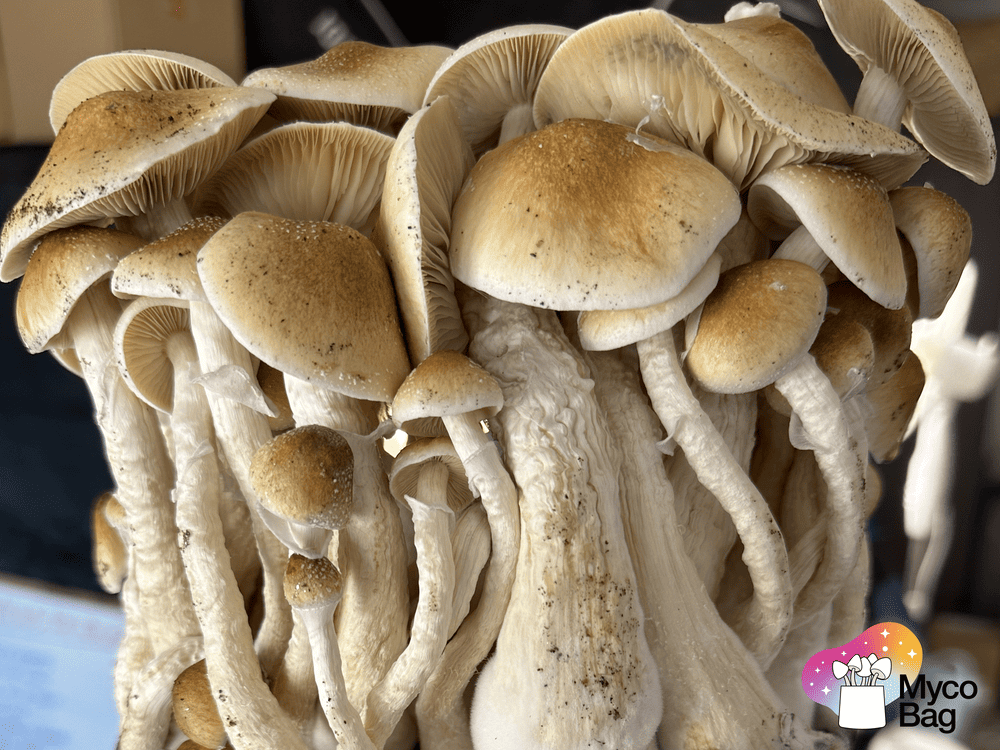
Albino Jedi Mind Fuck: a documented isolation
Albino Jedi Mind Fuck is one cultivar in the MycoBag catalogue for which we currently have detailed supplier documentation.
According to documentation supplied by Full Canopy Genetics, the original Jedi Mind Fuck lineage is described as originating from a wild Psilocybe cubensis specimen from Georgia isolated in the early 2000s.
Full Canopy describes AJMF as an albino isolation of that lineage. The specific genetic material used by Full Canopy was acquired from Denver Mycology, crossed with spores received from Edward Grand and subsequently worked and stabilised.
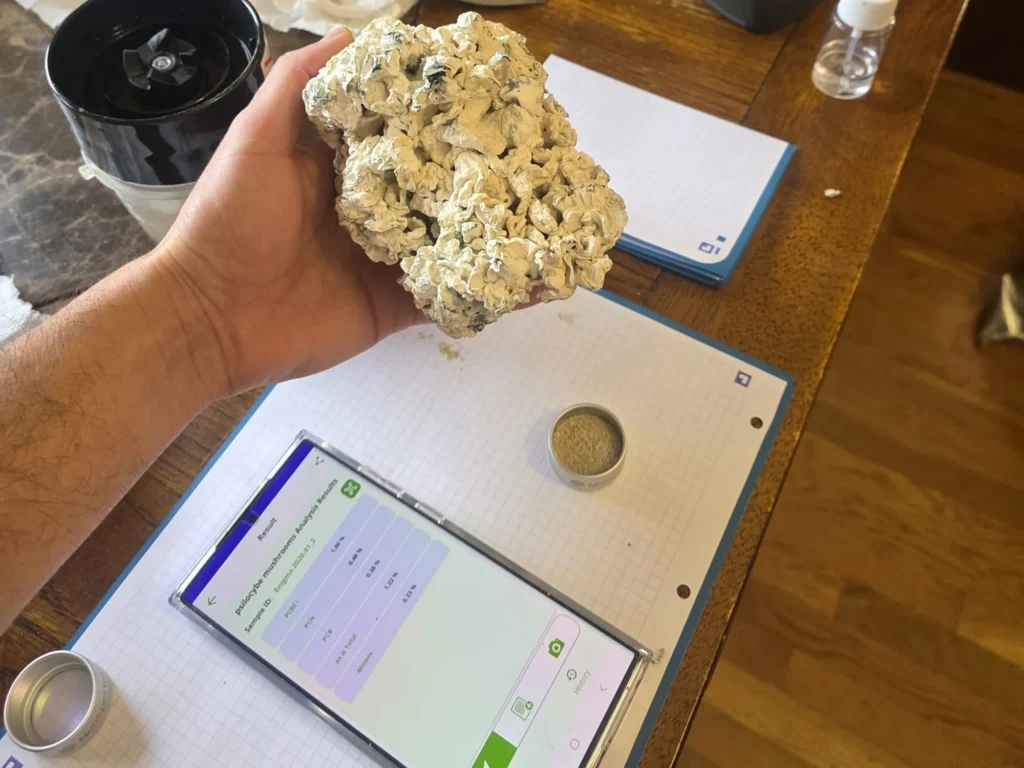
The supplier also reports multiple rounds of laboratory testing between May 2023 and November 2025. Any laboratory values from those tests should be understood as Full Canopy Genetics data, not as guaranteed performance for every MycoBag.
Other genetics in the MycoBag catalogue
The current MycoBag catalogue also includes Tidal Wave Ape, Whitebilly, Cascadian Teacher, Hydra and Mac Galactic.
Each name represents a different genetic and morphological context, which is why individual cultivar pages should be used for specific lineage information rather than assuming that all selected genetics share the same characteristics.
You can also compare the broader catalogue in our guide to mushroom varieties and genetics.
Genetics and phenotype are not the same thing
Genetics provides biological potential, but the visible result is a phenotype. Phenotype reflects the interaction between inherited information and the environment in which the organism develops.
This means morphology cannot responsibly be attributed to genetics alone. Growing medium, environmental conditions and other biological variables can also influence what is observed.
That relationship is one reason we treat substrate as a separate part of the system in our guide to mushroom substrates and growing media.
What should you look for in a documented mushroom cultivar?
When evaluating claims about mushroom genetics, look for information that can actually be traced:
- species identification;
- documented lineage or provenance;
- clear distinction between cultivar, phenotype and isolation;
- supplier or laboratory attribution for test data;
- specific morphology described without unsupported superlatives;
- clear separation between observed data and marketing claims.
A dramatic cultivar name is not evidence by itself. Documentation is what makes a genetic description useful.
Frequently asked questions about mushroom genetics
What are elite mushroom genetics?
“Elite mushroom genetics” is a commercial expression rather than a formal scientific classification. At MycoBag, we use it to describe selected cultivars with identifiable provenance or documented characteristics.
Are albino and leucistic mushrooms the same?
No. Both terms describe pigmentation-related phenotypes, but albino generally indicates a more complete loss of pigmentation, while leucistic is commonly used for partial reduction.
Does a hybrid automatically perform better?
No. Hybridisation describes genetic origin, not guaranteed performance. Yield, morphology or biochemical characteristics require separate evidence.
Can appearance prove mushroom genetics?
No. Morphology can provide useful clues, but phenotype is influenced by both genetics and environment. Reliable lineage claims need documentation beyond appearance alone.
Documented genetics over marketing claims
The most useful way to understand mushroom genetics is not to rank cultivars as “strongest”, “best” or “most elite”. It is to understand what the terminology means, where a genetic line comes from and which characteristics have actually been documented.
That evidence-first approach is how MycoBag aims to present genetics from Full Canopy Genetics: separating lineage, morphology, supplier data and commercial positioning rather than treating them as the same thing.
Explore the current MycoBag genetics catalogue →

 Sale!
Sale! Sale!
Sale!