Short answer: if your mushrooms or mycelium turn blue or blue-green, it is almost always oxidation, not contamination. When the tissue of a Psilocybe mushroom is bumped, cut or ages, psilocybin is converted into psilocin, and psilocin oxidises into blue pigments. That blue does not mean anything is wrong with your grow, and it does not mean the mushroom is more potent. What should worry you is an intense green, powdery mould that spreads on its own: that is contamination (usually Trichoderma).
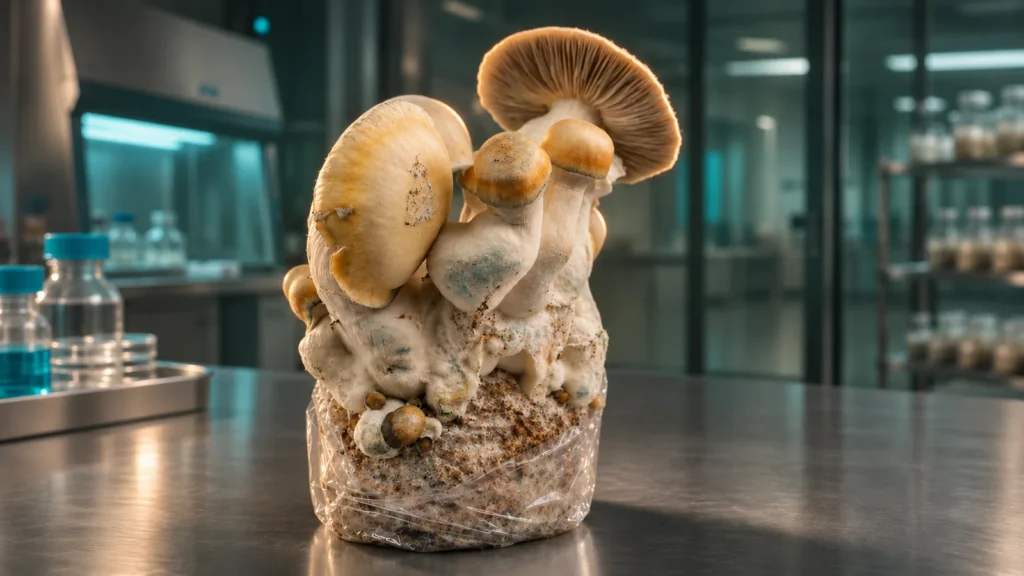
In this article we explain why the blue colour appears, where it is normal to see it, how to tell it apart from contamination and how to reduce it.
Psilocybin-containing mushrooms have a chemical system that switches on when the tissue is damaged. A study by Lenz and colleagues, published in 2020 in Angewandte Chemie, described the process in two steps:
The formation of a blue product from these compounds had already been described in 1967 in the journal Nature. So what you are seeing is psilocin breaking down. We explain the difference between the two molecules in psilocybin vs psilocin.
The shade ranges from light blue to blue-green, turquoise or almost black, depending on how much pigment there is and how much time has passed.
The most common question is whether a blue-green patch is mould. These differences help you decide:
| Feature | Oxidation (blue) | Green mould (Trichoderma) | Bacteria |
|---|---|---|---|
| Colour | Blue, blue-green or turquoise | Intense green, sometimes olive green | Grey, yellowish or brown |
| Texture | Same as the surrounding tissue, no powder | Powdery (spores); starts as a white patch | Wet, slimy or shiny |
| Where it appears | Exactly where there was a knock, cut or pressure | Anywhere on the substrate | Wet or waterlogged areas |
| Does it spread on its own? | No | Yes, it grows day by day | Yes |
| Smell | Normal, mushroomy | Mouldy | Sour or unpleasant |
| What to do | Nothing; handle more gently | Do not open the bag indoors | Do not open the bag indoors |
If in doubt, take a photo in good light and compare it a few days later: oxidation does not progress, contamination does. More symptoms in mushroom growing problems and in how to prevent Trichoderma.
Seeing bluish areas on the mycelium of a grow bag is common and, on its own, not a bad sign. It is usually caused by pressure on the bag, knocks during transport, temperature changes or the mycelium ageing in the later flushes. If the patch does not grow, is not powdery and the rest of the mycelium is white, the grow is on track. With a MycoBag all-in-one grow bag, the advice is the same as always: do not open the bag until harvest. We explain this in the complete guide to growing with a MycoBag grow bag.
No. Blue means psilocin is breaking down, so a heavily blued mushroom has lost some of those compounds in the damaged areas. The intensity of the colour depends mainly on how much the mushroom has been handled, its age and how it was dried. The only way to know the actual alkaloid content is a laboratory analysis, such as MycoTest.
Some mushrooms without psilocybin also turn blue when cut, such as several boletes, because of the oxidation of other compounds. And some psilocybin species barely change colour at all. That is why bluing should never be used to identify wild mushrooms: some toxic species look very similar to Psilocybe.
Because psilocin oxidises when the tissue is bumped, cut or ages. It is a natural process in Psilocybe mushrooms, not a disease of your grow.
Yes, especially where there is pressure or knocks, after temperature changes and in the later flushes. If the patch does not grow and is not powdery, it is not contamination.
Usually not. Green mould is powdery, starts white and spreads day by day; oxidation appears where there was damage and does not progress.
No. The pigment stays and over time can darken to a very deep blue or almost black.
No. Blue means some of the psilocin in that area has broken down; it cannot be used to measure content.
These are areas that oxidised before or during drying, from knocks or slow drying. Drying promptly and handling gently reduces them.

 Sale!